March 2026
Form or Freedom: de Kooning and the Defense of Abstraction
Willem de Kooning 1968, photo by Jack de Nijs (Anefo), via Wikimedia Commons. Licensed under CC BY 4.0(https://creativecommons.org/licenses/by/4.0/).

I’ve often found myself defending and discussing abstract art over the years, most notably in conversations with my ex-partner, whose skill and devotion laid firmly, for a long time, in portraiture and figurative art. The paintings of Willem de Kooning were frequently drawn into these pleasurable debates.
Recently my defence is rarely as articulate as I would like. I often lean on fragments of knowledge I gathered during my art diplomas, in addition to my natural reactions to the paintings themselves: the heavy brushwork, interesting compositions, choice of colour, dense physicality of paint, and the inexplicable pull his work has on me.
But over time I have begun to realise that I cannot always articulate why I defend him, or abstract art more broadly, with such conviction. Opinions that had once felt solid, have not been exercised in some time, and like any neglected muscle, they have started to weaken.
This is therefore a return to the life of de Kooning and to the movement he helped shape, undertaken partly as an act of re-education for myself, but also an attempt to articulate more clearly why abstract art, so often dismissed with casual ease, deserves far greater consideration than it typically gets.
For the purposes of this essay, I will focus largely on Willem de Kooning’s abstract work. While he frequently explored figurative painting throughout his career, and these works are significant in their own right, I am choosing here to emphasise the aspects of his subjectless art that shaped and defined abstract expressionism. This is not a dismissal of his figurative achievements, but a conscious choice to explore the power, emotion, and intensity of his abstraction, and abstraction as a whole.
De Kooning
Willem de Kooning was born on April 24th 1904 in the Netherlands, to parents who would soon divorce three years later.
Any attempt I could make to connect these early circumstances directly to his later artistic expression would certainly be speculative at best, although it is the sort of speculation that practically writes its own punchline. An early encounter with family upheaval didn’t exactly discourage a lifelong interest in expressing complex emotions on canvas, an idea that lingers a little close to home.
By 1916 he had left school and begun an apprenticeship with commercial artists. Alongside this, he attended evening classes at the Rotterdam Academy of Fine Arts and Applied Sciences. An institution that later became the Willem de Kooning Academy, a persuasive indication of his influence.
Those who discredit the achievements and accolades of artists associated with the movement seem to overlook this; if one becomes celebrated enough to have a school dedicated to the very field they are accused of undermining, bear their name, then the authority of such criticism begins to look incredibly narrow; less like discernment and instead a self-appointed attempt at gatekeeping.
In 1926, he traveled to the US as a stowaway aboard a freighter headed for Argentina, eventually landing in Virginia before moving on to New York.
Whenever I come across details like this in a beloved figure’s past, it’s difficult to ignore how differently immigration is discussed today. Long before every arrival is met with a chorus of online voices telling them to “go back home,” Willem had the privilege to take such a leap of faith—at least with far less global condemnation.
It raises an interesting question: who would de Kooning have become without that journey? Would remaining in the Netherlands have changed his role in shaping twentieth-century painting? Would the movement we now call Abstract Expressionism have looked the same? But that, of course, is a discussion for another time.
De Kooning’s early life in the US was far from glamorous. He worked as a house painter, carpenter, and commercial artist to support himself, painting what he truly desired only in his spare time.
People often dismiss abstract painters as idiots who simply “throw paint at a wall.”
Ironically, de Kooning quite literally began his American dream painting walls for a living.
The New York School and Abstract Expressionism
By the 1940s de Kooning had become part of the group now known as the New York School. This entourage included other debated artists such as Jackson Pollock, Lee Krasner, Mark Rothko, Franz Kline, and many others.
Together they played an integral role in shaping what we would later recognise as Abstract Expressionism, a movement that emphasised gesture, emotion, and physical involvement with painting, both in creation and observation.
Some artists became associated with what critics called Action Painting, famously we think initially of Pollock and his unique dancerly approach, where the act of painting itself becomes part of the artwork. This is something eagerly dismissed, or struck out completely from consideration when diminishing the value of the same paintings Fred Ross calls “some patches of paint and blots of color” in his article “Abstract Art Is Not Art and Definitely Not Abstract”. (https://www.artrenewal.org/articles/abstract-art-is-not-art-and-definitely-not-abstract/290)
For many artists, paint was not just a medium used to depict reality, which Ross seems to place complete and pedestalled importance on. Instead imploring that we subscribe to his definition that “Art is the selective recreation of reality for the purposes of expressing an idea”. I couldn’t disagree more with his narrow interpretation. To de Kooning and others, paint became something to be pushed, dragged, layered, approached, reworked and tested until their canvas carried the textural evidence of physical and emotional engagement. The work coaxed to discover itself, guided in its journey to being, with years of craft and experimentation, birthing styles and techniques that are distinctly their own and alive with passion. Whether the outcome resembled selectively something figurative, I suggest is entirely futile.
This is one reason I’m drawn to de Kooning’s work: it feels alive. His paintings are not static pictures but records of movement and struggle and the repeated engagement with what can be drawn from nothing.
I do not aim to devalue the work of those who choose to depict reality with literality by highlighting my adoration for work that exists in it's absence, and i state this clearly in hope to discuss how many who parade realism, or its offshoots, as the only valid and valuable pieces of art, do not seem to possess the same ability to recognise how various manners of art and creation hold significance and merit. I exist as proof of the ability to passionately enjoy and uplift both with just as much fervor as those who choose to belittle their differences.
Influence and Recognition
Willem de Kooning’s influence on modern art is undeniable. As a central figure in Abstract Expressionism, his work played a pivotal role in redefining painting in the mid-twentieth century, he shifted attention away from traditional representation and grew toward gesture, materiality, and the act of creation itself. His dynamic brushwork and ability to balance abstraction with traces of the human form positioned him at the forefront of the movement.
His significance has been consistently reinforced by major institutions. The retrospective exhibition at the Museum of Modern Art in 2011–2012 brought renewed attention to his work, presenting it to both new audiences and established scholars. Exhibitions of this scale not only celebrate his achievements but also reaffirm his lasting impact on the direction of contemporary art.
However, this level of critical and institutional recognition exists alongside a broader public ambivalence toward abstract art and particularly abstract expressionism. Despite its prominence within galleries, museums, and academic discourse, it continues to provoke mixed reactions and debate among wider audiences.
Which raises a simple question: why do so many people still dismiss it?
Subject Matter
One common criticism is that abstract art is lesser when lacking a clear subject matter. But this seems to me a matter of personal preference rather than a measure of worthiness, and definitely not strong enough to wage an outright attack on an entire movement. Plenty of people dislike figurative art too, yet we rarely dismiss an entire genre simply because we personally don’t enjoy it.
Music offers a useful comparison. Instrumental or orchestral music often has no literal subject matter, absent of lyrics to tether us to a specific intention, yet a symphony by Ludwig van Beethoven can move listeners deeply without a single word. These same critics, I would wager, do not declare it worthless simply because we cannot know whether a melody expresses sadness due to the loss of a lover or suffrage of another kind.
The lack of explicit context does not make the symphony meaningless, yet the same speculation about intent is often applied to abstract painting.
Abstract painting can convey emotion, tension, and movement without depicting a figure or narrative. The absence of literal forms is not a deficit; it is a creative tool that allows artists to explore ideas and internal experiences in ways that representation alone may not capture. What is “lacking” in literal content can become a richness of emotional and conceptual depth that many viewers may initially overlook. Critics seldom agree.
René Dewil in Lesson Seven of his “Educating Arte” series, argues that abstract works “show no recognisable objects or figures,” leaving the viewer searching for content that never arrives. (https://theartofpainting.be/AOP-Educating_Arte.pdf) Jakob Zaaiman describes abstract art as “completely devoid of narrative content… never more than shapes and colours on a surface,” and therefore cannot “offer a portal to any sort of experiential realm other than that of aesthetic sensation.” (https://philpapers.org/archive/ZAAUMA.pdf) Some go further, suggesting abstract work exists only for itself, or as pseudo‑intellectual play with formal elements rather than genuine communication. (https://paintersinfo.com/10-reasons-why-abstract-art-is-considered-not-to-be-art)
While these critiques focus on the absence of a literal subject, they overlook how humans naturally respond to emotion, movement, and expression. Emotional and conceptual resonance does not require literal representation or a guide. It arises directly from the work itself and the viewer’s engagement. Far from being “meaningless,” abstract art invites multiple interpretations, each valid, allowing viewers to respond in ways unique to their own experience. The absence of subject matter, rather than being a weakness, becomes a source of depth and richness.
Whether someone personally enjoys it or not could be debated for millennia, and I would have a lot less to say on the matter, but to take it to the extreme of dismissing such a pivotal exploration of artistry strikes me as completely pointless.
“I Could Paint That”
Another common criticism is the idea that abstract paintings require little skill. People often look at a Pollock or a de Kooning and say, “I could do that.”
The usual response to this is simple: but you didn’t.
I would take it a step further: but you don’t.
Most people who say this are not artists, do not study art, and rarely engage with it beyond quick glances in galleries. If abstract painting is truly so easy, and these works sell for large sums, why not make them yourself? Why not produce dozens and become wealthy?
What of the artists themselves that make this claim? Often pivoting to “a child could paint this” instead. This is still not proof of its ease, or proof of its theoretical inferiority. More often, it reflects a narrow definition of skill. One that prioritises precision and representation while dismissing other forms of artistic value. Abstract painting does not lack discipline; it simply operates by a different set of rules, requiring judgement, restraint, and sensitivity that are just as difficult to master as those demanded by the creation of The Mona Lisa.
The truth is that what looks spontaneous is often the result of sustained practice and experimentation. Knowing what to do, when to stop, and why something works is not accidental, it is learned. The difference between something that looks random and something that feels resolved is often invisible to those who have not spent time making or studying art.
As someone who has at points, spent time trying to step into the world of abstraction, I can say that it is incredibly easy to make a mess of a canvas in the hope of discovering the same sense of divinity many abstract expressionists achieved. Only for it to look unfinished and weighed down by amateurism. Many who know me, and notably, my ex-partner in particular, would say I am someone capable of inflating my own abilities. In which I will humorously accept if only for this point, in hope that it carries some weight when I say that even I can recognise, through my own attempts, that it is not as easy as it seems.
The Barrier of Understanding
Another problem is that people feel they must understand abstract art intellectually before they are allowed to experience it emotionally.
But we tolerate this lack of understanding in many other fields. Most people cannot explain advanced mathematics, yet we still respect mathematicians. Few of us truly understand the origins of the universe, yet we do not dismiss cosmology as meaningless simply because it is difficult. Why should art be any different? If someone doesn’t understand abstract art, that doesn’t mean it lacks value. It simply means they haven’t spent time learning its language. And I would go as far as to say, we do not always need that language to understand or enjoy it.
Tom Wolfe, in The Painted Word, suggested that much of modern art relies on intellectual framing rather than visual substance, implying that without theory or explanation, abstract art might appear empty or meaningless. This criticism echoes the common perception that abstract work is inaccessible without specialized knowledge. However, I strongly disagree. Even before I had the vocabulary to understand art, when I was much younger, I felt a profound pull toward abstract works. The emotionality was immediate and undeniable. Viewing Willem de Kooning’s work, I experienced awe and a sense of smallness, struck by the rawness and intensity of his brushwork. Long before I could articulate why, I understood that his paintings were deeply emotional; their power did not depend on critics, theory, or intellectual framing, it was felt directly, viscerally, in my own experience.
My ex-partner used to argue that art which relies entirely on the expression of emotion is a form of social gatekeeping, claiming that artists had a duty to make their work accessible to everyone. She argued, much like Wolfe, that without the proper vocabulary or intellectual framework, viewers could not interpret or fully appreciate it. I believe this perspective can be damaging. In reality, it risks undermining the intelligence and emotional capacity of those who have not had formal education in art.
And yet, just as we saw when discussing subject matter, and as classical music demonstrates, art can communicate powerfully without requiring literal representation or formal training. A symphony has no figures, no words, yet listeners can still experience profound emotional resonance. Similarly, the absence of a figure or narrative in abstract painting does not prevent people from understanding or feeling it. Emotional engagement is accessible to anyone willing to sit with the work, just as one can feel the depth of a symphony without needing to read the score.
I know many people, including myself, who can experience and appreciate the emotional power of abstract art without knowing all the theoretical language or critical terminology. I, too, felt the pull of abstract works long before I could dissect them intellectually. Human beings are capable of interpreting and responding to art in many ways. Intellectual understanding may deepen appreciation over time, but the baseline experience and the emotional connection is accessible to anyone willing to engage with the work. Art does not need to be mediated by theory to be meaningful; feeling it is already enough.
This direct, emotional engagement is exactly what makes de Kooning’s work, and abstract art more broadly, so valuable. It demonstrates that art does not need to be disected by theory to communicate. It can speak to the senses, to the heart, and to the imagination, and later, if wanted to the intellect.
The Question of Value
People also question the prices of abstract art. Large sums for paintings that appear to contain “simple shapes and colours” can feel suspicious.
But value in art has never been determined solely by technical difficulty. Context, influence, historical significance, and originality all play roles. When we look at de Kooning, we are not simply looking at paint on canvas. We are witnessing a pivotal moment in twentieth-century art, when artists radically redefined what painting could be.
The reasons art may sell for astronomical sums are based on so much more than perceived technical merit. If we attempted to create a scale of worthiness to validate the price of every artwork ever sold, we would quickly render the entire market impossible.
Some may find the work of any artist trite, and again, this is simply a matter of personal preference. To impose an opinionless standard on something so inherently subjective would mean ceasing all sales of art forever.
I admit, I have found myself gawking at art prices too, I am not far from understanding the surprise. But to single out abstraction alone for criticism is clearly discriminatory toward the genre. My point is not to debate the pricing of art as a whole, but rather to highlight the inconsistency: the price of a beloved Van Gogh's Starry Night or a David Hockney's A Bigger Splash is rarely questioned in the same way that a de Kooning or a Pollock is belittled. Inflated prices across the art world are a broader issue, but using a price tag as a tool to judge worth is a flimsy argument, and just another way to segregate what is deemed “valuable” from what is not.
What Is Art Anyway?
To repeat Ross once again, popular opinion defines art as “the selective recreation of reality.”
I ask: why MUST art recreate reality?
Photography already performs that task extraordinarily well. Aren’t artists free to explore other ways of communicating ideas, emotions, and experiences?
Even so, abstract art can still be seen as a “selective recreation of reality”, perhaps just not in the literal sense. Instead of objects, it recreates movement, emotion, tension, rhythm, and perception. Aren’t these just as real as physical things?
So why tether art to such limiting constraints?
I cannot think of a more boring way to experience, or to create art.
Why De Kooning Matters
For me, Willem de Kooning represents the essence of what art can be: persistence, risk, and the courage to explore the unknown. He arrived in a new country with nothing, worked with his hands to survive, and painted in almost every spare moment, ultimately helping to redefine what painting could mean.
Art does not need to mirror the world to be real. It does not need figures or objects to carry truth. Abstract art captures the movement, tension, emotion, and perception that constitute human experience itself. Those are realities every bit as profound as any photograph, portrait, or landscape.
Whether you love it or not, dismissing it outright, especially when it has shaped the cultural and emotional landscape of the twentieth century, says more about fear of the unfamiliar than about the work itself.
Even as Alzheimer’s began to take hold, de Kooning continued to paint, producing a remarkable body of work despite the progressive decline of his mind and body. He eventually stopped painting in the early 1990s, several years before his death, when the disease made it impossible to work. That final silence underscores, in the most human way, both the fragility and the persistence at the heart of his artistic journey.
And that is why I will continue to defend it. Not because it is easy, or simple, or comfortable, but because art, at its best, is alive, daring, and unapologetically free… a mirror to de Kooning himself.
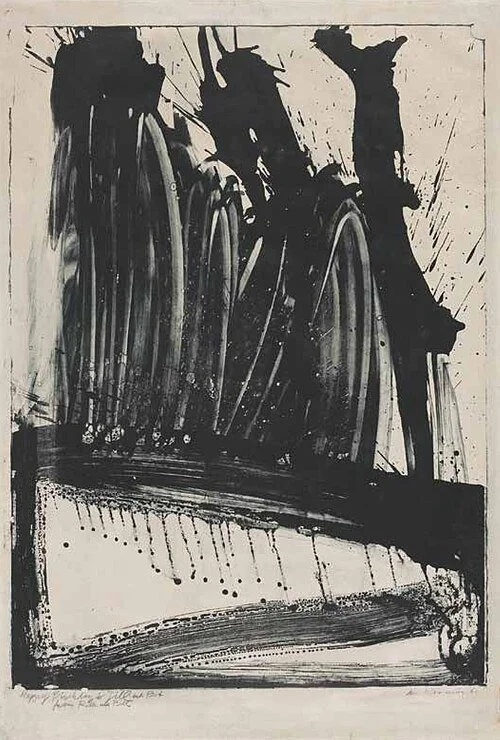
Litho #1 (Waves #1) by Willem de Kooning, 1960 - lithograph. Public domain (U.S. public domain) via Wikimedia Commons.
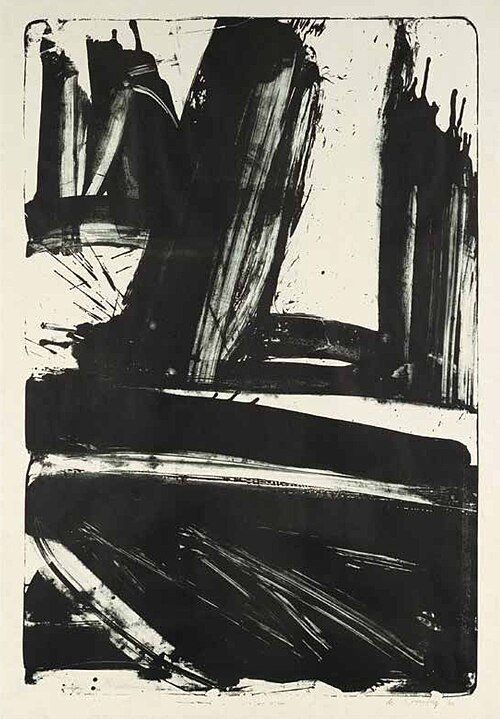
Litho #2 (Waves #2) by Willem de Kooning, 1960 - lithograph. Public domain (U.S. public domain) via Wikimedia Commons.